
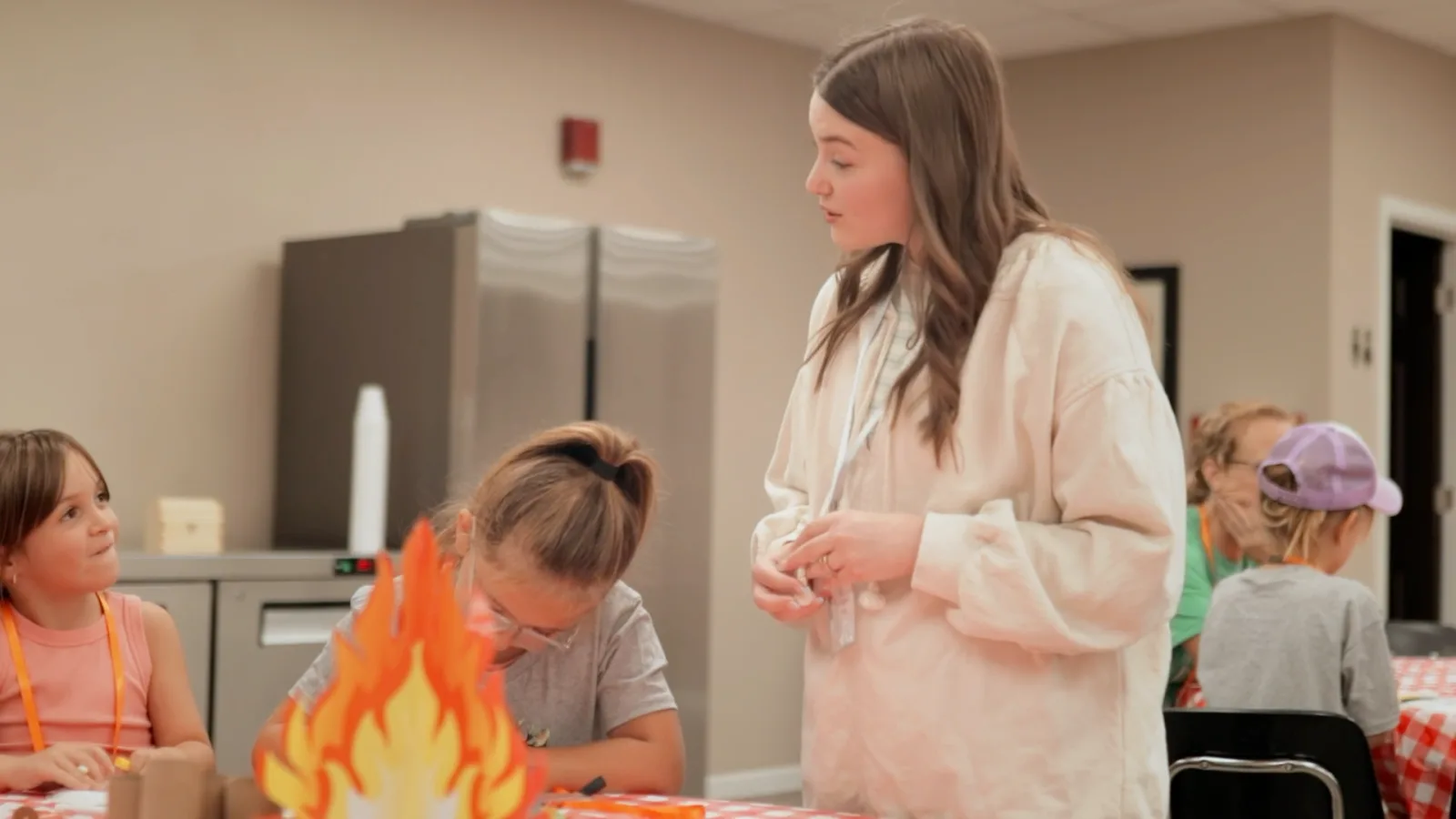
Students
We Are Not Responsible for Your Student’s Spiritual Care
That’s a pretty brash statement...but hear us out.
The family is an institution designed by God for HIS purpose. He has instructed parents to teach their children, to bring them up in the discipline and instruction of the Lord. Crossroads Church has no desire to usurp this anointing of God upon parents. As a matter of fact, even the most active, faithful family is not in corporate worship long enough for the church to do the work of teaching children the Word and the ways of Jesus.
HOWEVER, we can be an EXTENSION of the ministry happening @HOME. Our Elders and Family Ministry staff are here to complement the work you’re doing as disciple-makers of your own family, and to supplement you with biblical training and resources to engage, equip, empower, and encourage your family in their pursuit of Jesus and His Kingdom.
We love a family-inclusive Worship Gathering on Sunday mornings. For the first 18+ centuries of the church, children were not segregated out of the gathering of the church body. It wasn’t until the mid-1970’s that "children’s church" was established, and we’re not so sure that was a beneficial move.
Below, you’ll find a description of the student environments we provide and when they happen.
Sundays @ 6:00 PM
CSM (Youth)
Crossroads Student Ministry (CSM) is all about providing a COMMUNITY to help middle school and high school students develop a solid biblical worldview, wrestle with the truth of Scripture, and figure out how it applies to ALL OF LIFE.
We hope to create a place where their faith can be challenged and developed into something that is their own, not just a shallow belief in what they’ve been told growing up. We do so by challenging the social norms of our culture and discovering what Scripture says about our purpose in life.
CSM meets every Sunday evening from 6:00–8:30 PM at The Big House.
- 6:00–7:00 PM — we hang out, play games, and get to know each other.
- 7:00–8:30 PM — we worship and dive into the Word together, then break into small groups for discussion and accountability.

Sunday Morning Environments
We believe our students ARE the church and should be included and present when the church gathers. They’ll learn to worship and love God and honor His Word by observing and imitating Mom and Dad and the others around them.
HOWEVER, we understand that not every child is ready for that step, nor is every parent equipped to engage in the service and with their children at the same time. We offer age-appropriate environments for kids from nursery through fifth grade across our two Sunday services, with Bible engagement led by Jesus-loving volunteers who desire to build on the foundation being laid @HOME — not just childcare. See our Kids environments →
As for students 12+ — it’s our philosophy that they’re no longer children. We consider them adults-in-training, as Scripture suggests. 1 Corinthians 13:11 says, "When I was a child, I used to speak like a child, think like a child, reason like a child. When I became a man, I did away with childish things." We strive to equip them as young adults to mature in a walk with Jesus that’s personal and authentic. They’re encouraged to engage in church life alongside the adults, but we also provide an additional environment for discipleship and authentic, biblical community on Sunday evenings.
Frequently Asked Questions
How are my children kept safe?
We provide secure Check-In for your child’s safety and your peace of mind. Someone from our Guest Relations team will help you get set up with tags for you and your children. Hang onto your tag — you’ll need it to pick up your children. Once checked in, your children will stay in a safe, secure environment until you check them out after the Worship Service.
How does Crossroads handle leading children to faith in Jesus and baptism?
For many believers, fulfilling Jesus’ command to make disciples of all nations begins @HOME — with their children. Few experiences bring greater joy to Christian parents than seeing their children come to faith in Christ.
But evangelizing one’s children can be daunting. How should I present the gospel to my children? What’s the best approach? How do I know if I’m doing it right? Both real and imagined pitfalls intimidate virtually every parent who contemplates this responsibility.
The answer begins with recognizing and avoiding some common pitfalls in leading children to faith in Jesus and baptism.
If you have additional questions about Student Ministry at Crossroads, Contact Us →
Common Pitfalls in Leading Children to Faith
Oversimplifying the Gospel of Christ
Because a child’s comprehension is less developed than an adult’s, many parents are tempted to oversimplify the gospel’s message when they evangelize their children. Sometimes this stems from canned or programmed approaches to child evangelism, which often abbreviate the gospel, downplay its demands, or leave out key aspects altogether.
Like adults, children must be able to understand the gospel clearly before they can be saved — grasping good and evil, sin and punishment, repentance and faith, God’s holiness and wrath against sin, the deity of Christ and His atonement, and the resurrection and lordship of Christ. Parents need to use terminology children can comprehend, but Scripture’s emphasis is on thoroughness (Deuteronomy 6:6–7). Oversimplification is a greater danger than giving too much detail. It is the truth — found in God’s Word — that saves, but that truth must be understood.
Coercing a Profession of Faith
Whether parents present the gospel in an oversimplified or thorough manner, many solicit some active response — a show of hands, a rote repetition of "the sinner’s prayer," or almost anything counted as a positive response. Children will almost always respond in whatever way parents ask — not at all guaranteeing real acts of faith in Christ.
Rather than getting children to pray a scripted prayer, parents must faithfully, patiently, and thoroughly teach them the gospel and diligently pray for their salvation, always remembering that God is the One who saves. Genuine repentance will bring forth its own confession as the Lord opens the heart. It is never right to reinforce to a child that a childhood prayer is evidence of salvation.
Assuming the Reality of Regeneration
The next pitfall is assuming with certainty that a child’s positive response to the gospel is full-fledged saving faith. One cannot assume every profession of faith reflects a genuine work of God in the heart (Matthew 7:21–23), and this is particularly true of children.
Children often respond positively to the gospel for reasons unrelated to any awareness of sin — peer pressure at church, or a desire to please their parents. Scripture indicates children tend to be immature (1 Corinthians 13:11; 14:20), naive (Proverbs 1:4), foolish (Proverbs 22:15), inconsistent (Matthew 11:16–17), and easily deceived (Ephesians 4:14). Their judgment is shallow, and their ability to see the implications of their decisions is weak.
For this reason, only as a child’s stated convictions are tested by life’s circumstances do parents begin to learn more conclusively his spiritual direction. Many make a genuine commitment to Christ when young; many others don’t come to an adequate understanding of the gospel until their teenage years. Parents should move cautiously in affirming a child’s profession of faith and not be quick to take any show of commitment as decisive proof of conversion.
Assuring the Child of Salvation
After becoming convinced their child is saved, many parents seek to give that child verbal assurance of his salvation. Consequently, the church is filled with teenagers and adults whose hearts are devoid of real love for Christ, but who think they’re genuine Christians because of something they did as children.
It is the role of the Holy Spirit — not the parent — to give assurance of salvation (Romans 8:15–16). Parents should commend and rejoice in the evidence of real salvation in their children’s lives only when they know the child understands the gospel, believes it, and manifests genuine evidence of true salvation — devotion to Christ, obedience to the Word, and love for others.
Rushing the Ordinance of Baptism
A final pitfall is having the child baptized immediately after professing faith. Although Scripture commands that believers be baptized (Matthew 28:19; Acts 2:38), it’s best not to rush into the ordinance in the case of a child. It’s wiser to take the ongoing opportunity to interact with them and wait for more significant evidence of lasting commitment.
Here at Crossroads, our general practice is to wait until a professing child has reached the age of twelve. Because baptism is seen as something clear and final, our primary concern is that a younger child tends to look to that experience as proof he was saved — which, in the case of an unregenerate child, actually does him a disservice. It’s better to wait until the reality to which baptism testifies can be more easily discerned. HOWEVER, given that parents are the established authority over the home, we would not refuse baptism to a child under twelve who can verbally share their confession of faith and understanding of a believer’s baptism, and whose parents are in agreement against waiting.
Foundational Keys to Leading Children to Faith in Jesus
Setting a Consistent Example of Godliness
Evangelizing children consists not simply of verbalizing the gospel, but exemplifying it in one’s life. As parents explain the truths of God’s Word, children have the unique opportunity to observe their lives up close and see whether they seriously believe what they’re teaching. Because marriage is a picture of Christ’s relationship with the church (Ephesians 5:22–33), a healthy, Christ-centered marriage is one of the most crucial foundations for successful parenting.
Proclaiming the Complete Gospel of Christ
The heart of evangelism is the gospel, "for it is the power of God for salvation to everyone who believes" (Romans 1:16). Parents need to teach their children the law of God, the gospel of divine grace, their need for a Savior, and point them to Jesus Christ as the only One who can save them — starting from the beginning: God, creation, the fall, sin, salvation, and Christ in His life, death, and resurrection.
Parents must resist the temptation to downplay the demands of the gospel. The key is to be clear and thorough, treating every moment of a child’s life as a teaching opportunity (Deuteronomy 6:6–7) — including discipline, which should point a child to their need for forgiveness in Christ, not just correct behavior.
Understanding the Biblical Evidences of Salvation
The evidence that someone has genuinely repented and believed in Christ is the same in a child as in an adult — spiritual transformation. True believers follow Christ (John 10:27), confess their sins (1 John 1:9), love their brothers (1 John 3:14), obey God’s commandments (1 John 2:3; John 15:14), abide in God’s Word (John 8:31), and do good works (Ephesians 2:10). Parents should look for an increasing measure of this fruit while also guarding their children against thinking they’re saved when they’re not.
Encouraging Possible Signs of Conversion
It’s tempting for parents to write off childlike expressions of faith as trivial. Instead, parents should encourage every sign of faith in their children and use the opportunity to teach them even more about Christ and the gospel. Even if it’s too early to regard a child’s interest as mature faith, parents must not deride a profession of faith as false — it may be the seed from which mature faith later emerges.
Trusting the Absolute Sovereignty of God
The greatest need of children is to be born again — and regeneration is not something parents can do for them. Genuine faith and repentance can only be granted by God, who regenerates the heart (John 3:8). The salvation of children cannot be produced by the faithfulness of parents but only by the sovereign work of God Himself. This should bring comfort to parents, and it should motivate them to bathe their evangelistic efforts in prayer to the One who does His work where they cannot — in the child’s heart.